When the Body Breaks and the Person Remains: Why Elite Sport Needs Room for the Soul.
Two seasons ago I started working with Matt Rowell. In that time I've watched him from close range - not just as an athlete chasing form, but as a young man navigating one of the most publicly scrutinised professions in the country. What strikes me most, watching that journey unfold, isn't the highlight reel. It's what happens in the gaps: the rehab room, the quiet mornings before a session, the moments when the body has let him down, and all that's left to lean on is who he is underneath the guernsey.
That closeness is why I'm writing this. This isn't an outside commentary on elite sport - it's an account from someone who, with Matt, has, over the years, developed a genuine, soulful, and deeply respectful professional relationship, built on honesty, transparency, trust, and a shared commitment to growth.
Rowell's career is, in many ways, a case study in why this conversation matters. He arrived at Gold Coast as the No.1 pick in the 2019 draft and looked, from his first four games, like a generational talent - before a serious shoulder injury and a PCL tear derailed that start entirely. It took years of unglamorous rebuilding before that potential became a peak: a 2025 season strong enough to win the Brownlow Medal with 39 votes. And now, this year, he's navigating another injury-interrupted stretch that has, by his own club's admission, "been one of his toughest since that rookie setback."
That arc - breakout, breakdown, rebuild, summit, and now another test - isn't a story about talent management. It's a story about what sustains a person through years where the body and the scoreboard refuse to cooperate. And that's precisely the terrain elite sport is least equipped to work in.
The Machinery We've Built, and the Room We Haven't.
Modern AFL programs are extraordinary machines. Every club now runs sophisticated physiotherapy and strength-and-conditioning units, GPS-tracked load management, sports science modelling, and, increasingly, performance psychology. We have built entire departments to manage the body and, more recently, the mind.
What we have not built, in any serious or consistent way, is room for the spirit - the part of a person that asks not "how do I perform," but "who am I, and what is this for." Not necessarily religion, though for some players it is exactly that. I mean something broader: a person's sense of meaning, their connection to something larger than themselves, the values they return to when performance and identity threaten to collapse into one.
Elite sport is one of the few professions in the world where a person's worth is publicly re-litigated every single week based on output. A dropped mark, a quiet quarter, an injury - and suddenly the question isn't "how did the team play" but "what's wrong with him." For a young athlete who has never had cause to separate his sense of self from his output, that pressure doesn't just test skill. It tests the soul.
Why "Spirituality" Isn't a Soft Word.
I understand the instinct in high-performance environments to flinch at that word. It sounds unmeasurable, undisciplined, out of step with the KPI-driven culture clubs run on. But spirituality, properly understood, is one of the most practical assets a person can carry into a career defined by uncertainty.
It's the internal ground a player stands on when external validation disappears - during a long rehab, a form slump, a trade period, a season that doesn't go to plan. It's the capacity to ask what do I value, what am I here to build, who am I when the guernsey comes off - questions that, answered honestly, produce steadier decision-making, longer careers, and healthier retirements than pure performance psychology ever will on its own.
Consider what an injury actually does to an elite athlete. It doesn't just remove them from the team sheet - it removes the primary mechanism through which they have understood their own value since childhood. Watching Matt move through repeated injury setbacks over several years, what has mattered as much as the physical rehab has been the internal work: reconnecting to purpose that exists independent of games played, learning to sit with the discomfort of being unproductive in a culture that worships output, and finding - sometimes rebuilding from scratch - a reason to keep showing up when showing up hurts and offers no guaranteed return.
I don't say this as a distant observer of that process. I've sat in it with him - across the highs of a Brownlow-calibre season and the grind of a body that won't cooperate - and it's some of the most meaningful work I've been part of. That is spiritual work. It is not separate from performance. It is the foundation on which performance stands.
Individual Growth: From Performing a Role to Inhabiting a Self.
When a player is given genuine space to explore what grounds them - whether that's faith, philosophy, family, service, or a personal ethic - something shifts in how they carry pressure. Instead of a young man whose entire identity rises and falls with selection, you get someone with a self that persists through selection.
This shows up in concrete ways:
• Resilience through setback becomes less about gritting through and more about genuinely metabolising hardship - an injury is a season of forced stillness rather than a personal indictment.
• Decision-making under scrutiny improves, because choices are anchored to values rather than to managing perception.
• Longevity improves, because a career built on an unstable identity burns out faster than one built on a stable one.
• Post-career transition - one of the most under-addressed crises in professional sport - becomes survivable, because the athlete was never entirely reducible to the athlete.
None of this is speculative. It's the difference between a player who is performing a role and a player who is inhabiting a self that happens to include football. I've had the privilege of watching that shift happen in real time in Matt, season by season, and it's exactly why this work doesn't feel finished to me - it feels like it's just reached its most interesting chapter.
Collective Growth: What a Grounded Individual Gives the Team.
The benefit doesn't stop at the individual. A locker room full of players who have done this work - who know who they are outside the numbers - produces a different kind of culture entirely.
Teams built on identity fused with performance tend to fracture under pressure: blame circulates, trust is conditional on form, and leadership evaporates the moment adversity hits. Teams with players who have a grounded sense of self tend to hold together precisely when it matters most - during a losing stretch, an injury crisis, a public setback. Vulnerability becomes something that can be shown without it threatening status. Leadership becomes less about being the best player and more about being the most whole person in the room, which is a far more durable form of influence across the full arc of an elite career, including seasons like the one Matt is having right now.
This is the part clubs consistently under-invest in. They will pay handsomely for a marginal gain in GPS data. They rarely invest with the same seriousness in the internal architecture that determines whether a player can absorb a public slump without unravelling, or whether a young leader can hold a room together when the results aren't there.
Why Clubs Resist This, and Why That Resistance Is Costing Them.
Part of the resistance is structural: performance departments are built around what can be measured, and the spiritual dimension resists being reduced to a spreadsheet. Part of it is cultural: sport has historically conflated toughness with silence about inner life, and any language that sounds introspective can still be read internally as weakness or distraction.
AFL clubs already have a partial answer within their own structures and underuse it: club chaplaincy exists across the league, but it is too often treated as pastoral care for crises rather than as a genuine, ongoing developmental pillar alongside medical and psychological staff. That's a missed opportunity. The work of spiritual and existential grounding shouldn't be reached for only when someone is struggling - it should be as embedded and preventive as strength training.
The other part of the resistance is simpler: it requires clubs to accept that a player is a whole person before he is an asset. That's an uncomfortable admission inside industries built on list management and trade value. But the clubs that make that admission honestly - that build real space for players to explore meaning, values, and identity beyond output - will produce more resilient athletes, healthier cultures, and, not incidentally, better and longer performances on the field.
What Real Space Looks Like.
Making room for this doesn't require every club to adopt a particular faith framework or soften its performance standards. It requires:
• Integrating existential and values-based work into the performance program itself - not as an optional extra bolted on when someone is struggling, but as a standing part of player development from day one on the list.
• Elevating chaplaincy and mentorship roles to sit alongside medical and psych staff in genuine strategic conversations about player welfare, not just crisis response.
• Normalising language of meaning and purpose in the same rooms where game plans and load management are discussed, so players don't have to compartmentalise who they are from what they do.
• Protecting time and privacy for this work, the same way a club protects an ice bath schedule or a leadership camp - treating inner life as a genuine performance and welfare pillar, not a luxury squeezed into whatever's left of a player's week.
My Own Commitment.
I want to be direct about where I stand in all of this, because advocacy without accountability is just opinion. This work with Matt isn't a project with an end date. Two seasons in, I'm as committed to his continued growth - as a person first, and as a footballer because of it - as I was on day one, and I intend to be there for whatever the next chapter of his career asks of him: the seasons that go well, the ones that don't, and everything in between that a body and a career like his will inevitably deliver.
That's the commitment underneath this whole piece. It's easy to argue, in the abstract, that clubs should make space for spirituality. It's another thing to actually show up for it, year after year, with one specific person, through Brownlow nights and injury setbacks alike. I've chosen to do the latter, and I'll keep choosing it, because I've seen firsthand what that steadiness makes possible - not just for Matt, but for what it could mean if more clubs backed this kind of ongoing relationship rather than treating it as optional.
Matt's story isn't finished, and it was never going to move in a straight line - few elite careers do. What I've seen across these two seasons is a young man doing the harder, quieter work of building a self that can hold both a Brownlow Medal and one of the most challenging seasons of his career without being shattered by either. That capacity didn't come from a game plan. It came from making room for the part of him that exists whether or not the ball bounces his way - and from having someone committed to standing in that room with him for the long haul.
That's the case for spirituality in elite sport, in a single sentence: it is the part of a person that survives both the best season of their life and the worst one - and I intend to keep showing up for that work, with Matt and beyond, for as long as it takes.
M x
Alchemy of Evolution
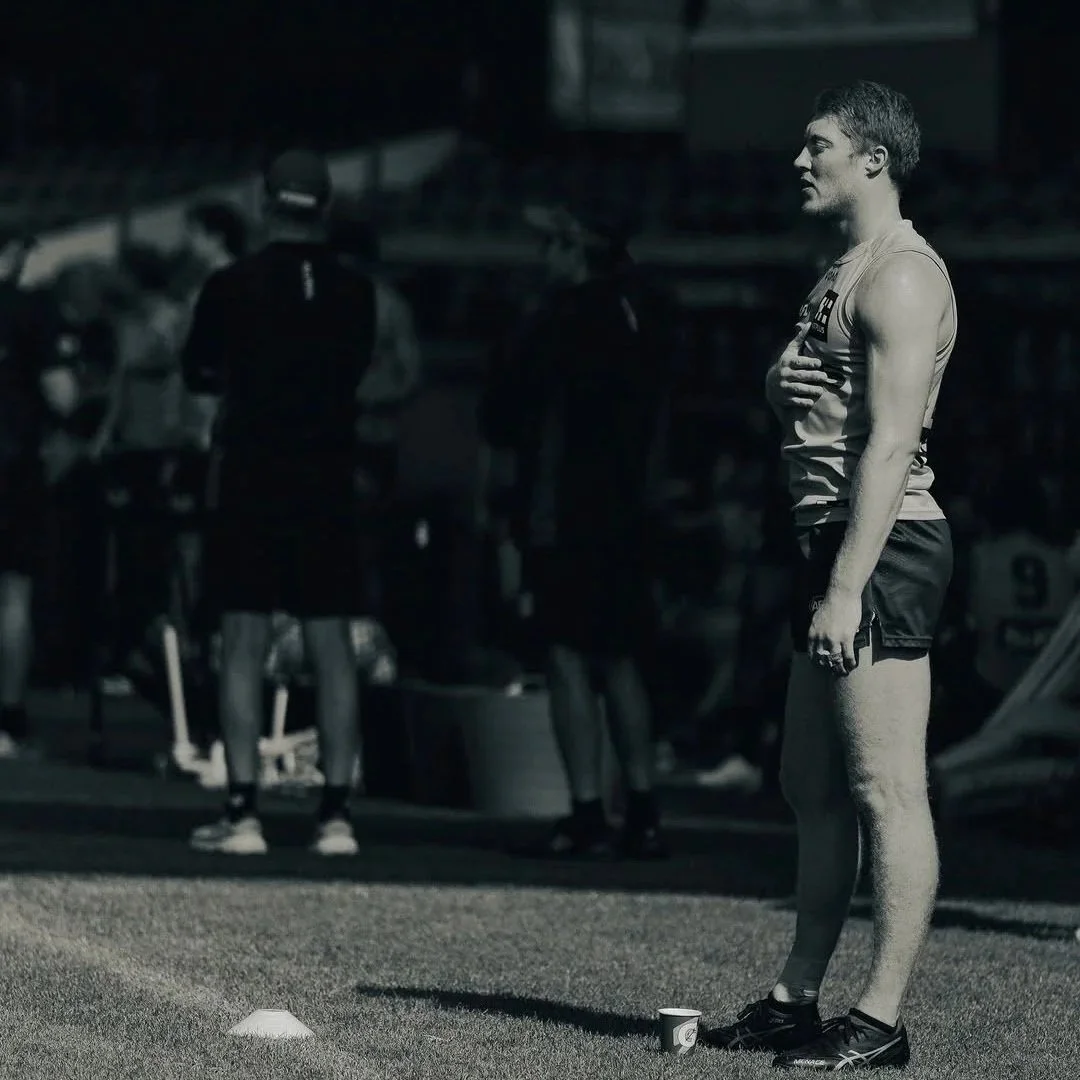
Image credit: Gold Coast Suns